Description
MPU-6050 6-Axis Gyroscope and Accelerometer Module
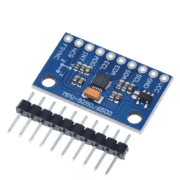
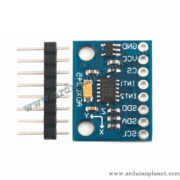
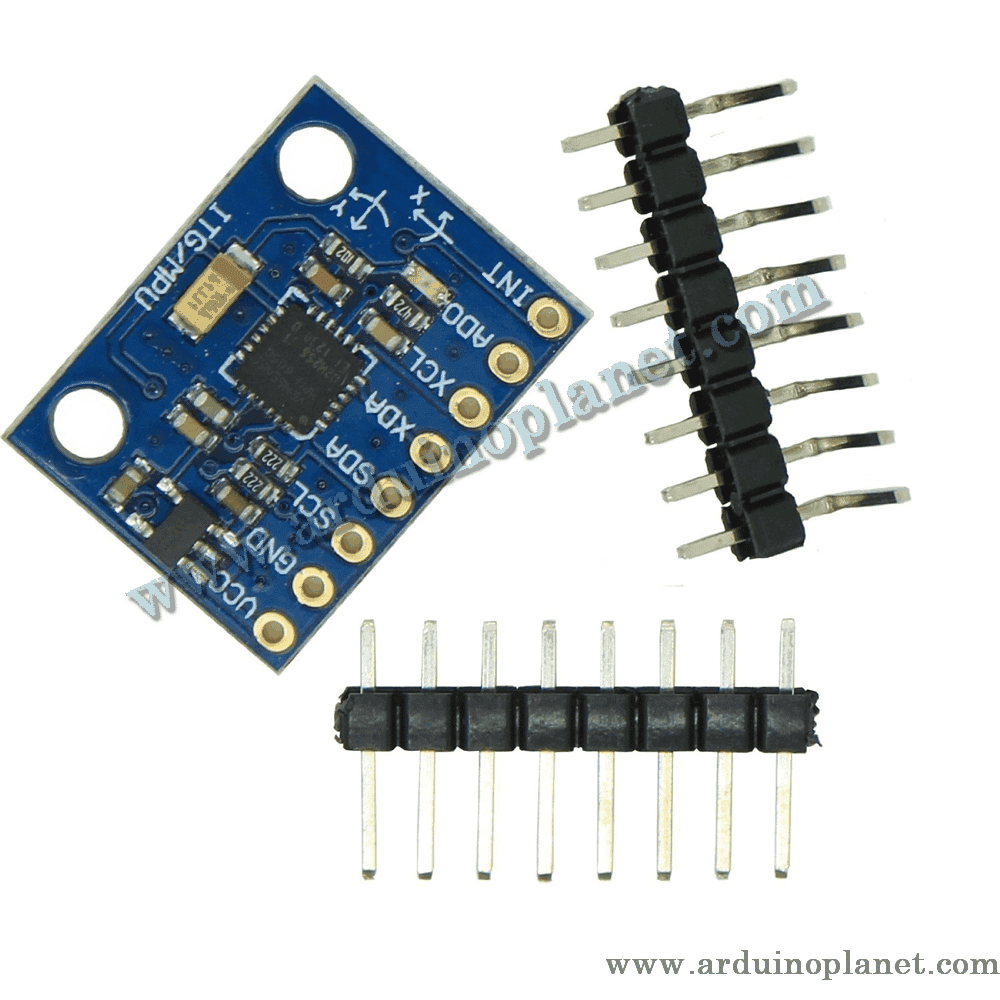
This motion-sensor module is based on the MPU-6050 and combines a three-axis accelerometer with a three-axis gyroscope. It provides digital motion measurements over I²C. It is a six-axis IMU, not a nine-axis compass: a magnetometer is required for magnetic heading or nine-axis sensor fusion.
🔧 Sensor specifications
- Accelerometer: three axes, programmable full-scale ranges of ±2 g, ±4 g, ±8 g and ±16 g
- Gyroscope: three axes, programmable full-scale ranges of ±250, ±500, ±1000 and ±2000 degrees per second
- Resolution: 16-bit ADC outputs for the accelerometer and gyroscope measurements
- Host interface: I²C on the MPU-6050; the chip specification supports I²C up to 400 kHz
- The chip includes a Digital Motion Processor (DMP) and an auxiliary I²C interface for an external sensor; the exact firmware/library determines which processing and sensor-fusion features are available
- The source listing states a 3–5 V input for the breakout board, while the MPU-6050 chip itself operates from 2.375–3.46 V. Carrier boards differ: check whether this board includes a regulator and how its I²C pull-ups are wired. Do not apply 5 V directly to the chip or assume 5 V-safe logic.
⚙️ Connection and setup
Connect the board’s documented supply and ground, then SDA and SCL to the host I²C bus. Confirm the breakout’s allowed input voltage and I²C logic levels before connecting to a 5 V controller; use a level shifter if needed. Keep the sensor firmly mounted and align its axes with the directions used by your software.
Select the required accelerometer and gyroscope ranges in firmware. Calibrate offsets with the sensor stationary, and account for gyroscope drift over time. Accelerometer readings include gravity and respond to vibration; filtering and sensor-fusion algorithms may be needed to estimate orientation smoothly. A magnetometer is needed to correct yaw drift against magnetic north.
💡 Typical uses
- Motion, tilt and vibration sensing in microcontroller projects
- Orientation experiments and basic inertial measurement
- Robotics, stabilization and gesture-recognition prototypes
Measurement quality depends on mounting, calibration, vibration, temperature, board layout and software. This development module is not a certified navigation or safety instrument.