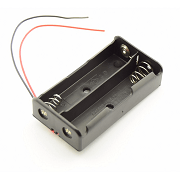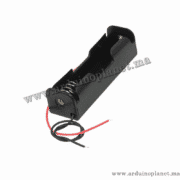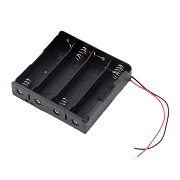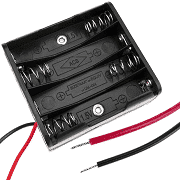
Description
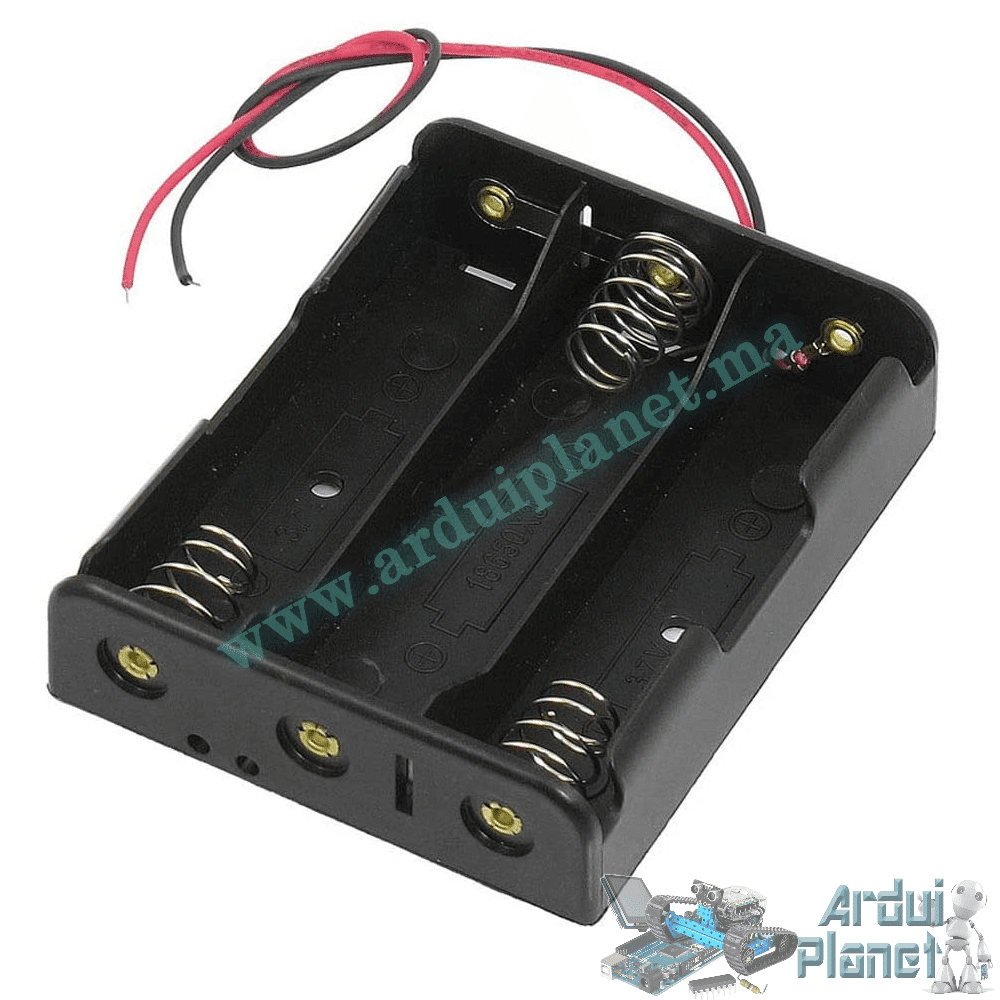
3-Cell 18650 Battery Holder in Series — 11.1 V Nominal
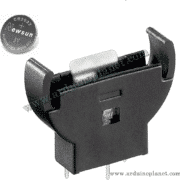
This holder connects three 18650 cells in series, giving a nominal pack voltage of 11.1 V and up to 12.6 V when all three cells are fully charged (using cells rated 4.2 V maximum each). It lets you replace cells without soldering directly to them. The holder has positive and negative output; its output is unregulated and falls as the cells discharge.
Features
- Holds three 18650 cells
- Internal 3S series connection
- 11.1 V nominal; 12.6 V maximum pack voltage as listed
- Replaceable cells; no direct cell soldering
- Compact format for electronics and robotics projects
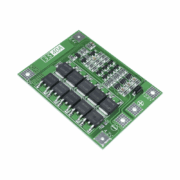
- Compatible with a suitable external 3S BMS (not included)
Specifications
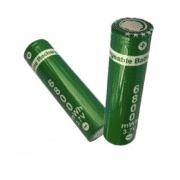
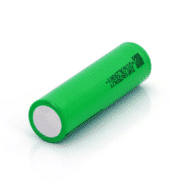
- Cell format: 18650 cylindrical cells
- Cell count/configuration: 3 cells, 3S series
- Nominal voltage per cell: 3.6 or 3.7 V
- Nominal pack voltage: 10.8 or 11.1 V
- Maximum pack voltage: 12.6 V; 4.2 V maximum per cell as stated
- Output: positive and negative
- Built-in charging: no
- Built-in BMS protection: no
- Batteries included: no
The exact low-voltage cutoff depends on the cells and protection system. Do not use the approximate 9 V low-pack figure as a universal cutoff.
How series connection works
In series, cell voltages add while amp-hour capacity remains that of one cell.
Cellule 1      Cellule 2      Cellule 3
  3,7 V    +     3,7 V    +     3,7 V
             = 11,1 V nominal
For three 3.7 V, 3000 mAh cells, the listed example is:
- Nominal pack voltage: 11.1 V
- Maximum pack voltage: 12.6 V
- Capacity: 3000 mAh, not 9000 mAh
Indicative 3S pack voltage
| Pack state | Indicative total voltage |
|---|---|
| Fully charged | 12.6 V |
| Nominal | 11.1 V |
| Low battery (source estimate) | About 9 V |
| Excessive discharge | Avoid |
The safe minimum depends on the cell manufacturer’s specifications and the protection circuit. A battery-management system (BMS) must be appropriate for the cells and project current. The holder itself provides no cell balancing or protection.
Charging and protection
For a rechargeable pack, use a properly designed 3S protection/BMS system and a charger intended for a 3-series lithium-ion pack. The source specifies a 12.6 V CC/CV charger. A BMS is not a charger, and a generic 12 V supply or single-cell 4.2 V charger is not a substitute. Confirm that the BMS provides the required cell-level protection and balancing for your cells; follow the cell maker’s limits. Series lithium-ion cells require individual cell monitoring/protection because total pack voltage alone cannot show whether one cell is overcharged or over-discharged.
Source usage sequence (verify your protection and wiring first)
- Use three compatible cells of the same model, capacity and similar condition.
- Check that their voltages are reasonably matched before assembly.
- Insert each cell according to the holder’s + and − markings.
- Measure the holder output with a multimeter.
- Connect the holder to a correctly wired 3S protection system suitable for the current.
- Connect the protected output to the device.
- Charge only with a suitable 3S lithium-ion charger and the required protection.
Example connection
3 cellules 18650
        │
Porte-batteries 3S
        │
      BMS 3S
        │
Interrupteur + fusible
        │
 Circuit ou appareil
Add a DC-DC converter between the protected pack and load if the circuit needs a stable voltage. Select the converter, BMS, wiring and fuse for the actual current and voltage.
Important precautions
- Do not mix cells with different capacities or specifications; use a matched set.
- Do not mix new and used cells.
- Check cell voltages and polarity before installation.
- Never short-circuit the holder output.
- Do not charge this pack with a 1S/4.2 V charger or a generic 12 V supply.
- Use a suitable 3S charger and protection system, and follow the cell manufacturer’s limits.
- Do not use cells that are swollen, corroded or have damaged insulation.
- Ensure the device tolerates up to 12.6 V, not only 11.1 V nominal.
- Use a correctly rated fuse where needed.
Applications listed
- Robots and electronic vehicles
- Small motors and geared motors
- Compatible 12 V LED lighting
- Portable audio amplifiers
- Wireless communication equipment
- DIY portable power projects
- Alarms and security systems
- Standalone measurement stations
- Solar projects with a suitable charger
- 3S lithium-ion packs