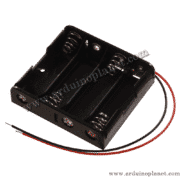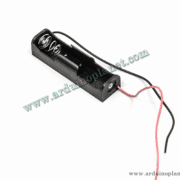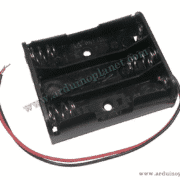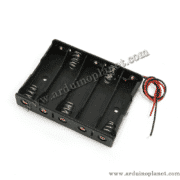
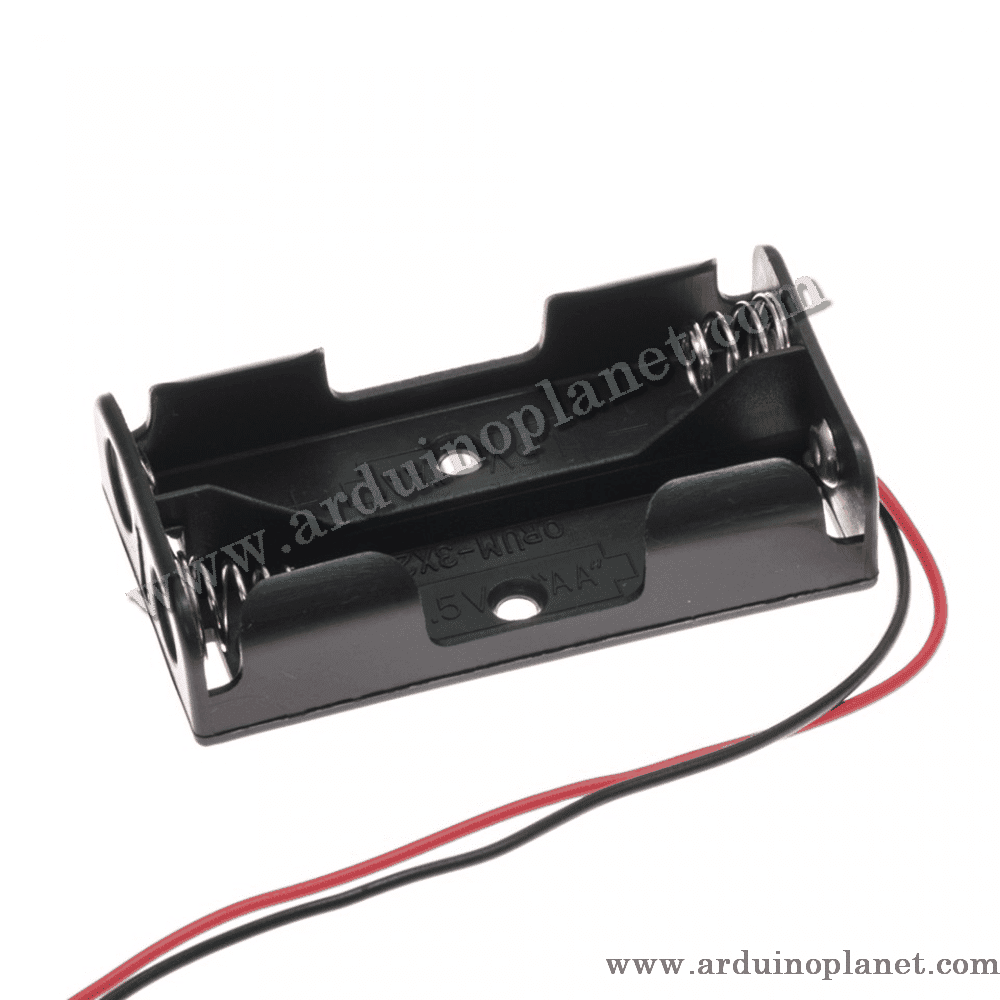
Description
🔋 2×AA Battery Holder in Series — 3 V or 2.4 V Output
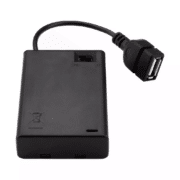
This holder for two AA batteries powers an electronic circuit without soldering directly to the cells. The two slots are connected in series, so their voltages add together.
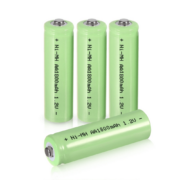
It supplies a nominal 3 V with two 1.5 V alkaline cells, or 2.4 V with two rechargeable 1.2 V NiMH cells.
✨ Features
- Holds two AA batteries or rechargeable cells
- Internal series connection
- 3 V output with alkaline cells
- 2.4 V output with NiMH cells
- Batteries can be replaced easily
- Avoids soldering directly to the cells
- Simple to install in a prototype
- Compact format
- Suitable for small electronics projects
🔧 Main specifications
- Type: holder for cylindrical batteries
- Compatible size: AA
- Number of slots: 2
- Configuration: 2S
- Electrical connection: series
- Voltage with alkaline cells: 1.5 V × 2 = 3 V
- Voltage with NiMH cells: 1.2 V × 2 = 2.4 V
- Output: positive and negative
- Built-in charging: no
- Voltage regulation: none
- Batteries included: no
Actual voltage gradually decreases as the cells discharge and may also drop when the circuit draws a high current.
⚙️ How the series connection works
In a series connection, the voltages of the two batteries add together. The pack capacity, however, remains the capacity of one battery.
Pile 1         Pile 2
 1,5 V    +     1,5 V    = 3 V

Accu 1         Accu 2
 1,2 V    +     1,2 V    = 2,4 V
With two 2,000 mAh cells, the pack supplies about 2.4 V and 2,000 mAh, not 4,000 mAh.
🛠️ How to use
- Check the voltage required by your device.
- Choose two matching AA alkaline cells or two matching NiMH cells.
- Locate the + and − marks in each slot.
- Insert both cells in the marked orientation.
- Measure the output voltage with a multimeter.
- Connect the holder positive lead to the circuit positive input.
- Connect the negative lead to circuit GND.
- Add a switch if you want to control the power supply.
If the holder has wires, red usually indicates positive and black negative. Verify polarity before connecting.
🔌 Connection example
Porte-piles + ─── Interrupteur ─── VCC du circuit
Porte-piles – ──────────────────── GND du circuit
⚠️ Precautions
- Do not mix an alkaline cell with a rechargeable cell.
- Use two cells of the same brand, capacity and charge condition.
- Do not combine a new cell with a used one.
- Never recharge alkaline cells.
- Remove NiMH cells and recharge them with a suitable charger.
- Observe the polarity in each slot.
- Never short-circuit the two outputs.
- Remove the cells if the assembly will not be used for a long time.
- Do not use a cell that is leaking, hot or damaged.
🎯 Applications
- Small robots and electronic toys
- LEDs with a suitable resistor
- Displays and small modules
- Low-voltage audio circuits
- Electronics exercises and lab projects
- Prototypes and DIY builds
- Buzzers and alarm systems
- Autonomous sensors
- Small electronic controllers
Keywords: holder, battery.